








How the Fed’s Hike Impacts Canadian Mortgage Rates
September 21, 2026
 The current consensus narrative in the bond market is that spiking energy prices will lead to more generalized inflation pressure. There is little evidence of this occurring thus far, but as the narrative goes, the longer energy prices remain elevated, the greater the likelihood that it will occur.
Given that there is no end to the Iran war in sight, a long period of elevated energy prices looks increasingly likely at this point, along with the concomitant inflation rise. Bond-market investors have responded by pushing bond yields higher and by pricing in five Bank of Canada (BoC) rate increases by the end of 2027.
I’m not convinced that an extended period of higher energy prices will automatically lead to more generalized inflation.
Here are three reasons why I write that:
- Higher energy prices act like a tax on other spending.
Higher energy prices act like a tax on other spending because households can’t easily reduce their energy consumption. As such, those higher prices sop up more of each consumer’s disposable cash. Simply put, the impacts from putting more money in the tank and spending less on other items are disinflationary.
- There is no evidence of a pass through to wages.
If workers respond to higher prices by demanding wage increases and if those demands are successful, that can create a self-reinforcing wage/price spiral. We saw an example of this at the end of the pandemic when a wage/price spiral became a significant inflation accelerant.
But labour-market conditions were tight then, and they are much weaker now. Average Canadian wage growth has fallen sharply from 3.3% in June to 2.8% in July to 2.0% in August, its lowest level in nine years (excluding 2021 when the data were distorted by the pandemic).
It is highly unlikely that we will see a sustained and broad-based inflation rise without a corresponding pass-through to wages, and there is not even a hint of one occurring thus far.
- Businesses have room to absorb higher input costs.
While there is no arguing that higher energy prices are raising input costs for businesses, those businesses currently have wider-than-normal profit margins with which to absorb those increases,
In a recent report, Statistics Canada noted that “Canadian corporate profit margins have widened sharply, with operating profits rising 15% year-over-year in Q2”.
Consider also that the latest Business Outlook Survey from the BoC, for Q2 2026, found that while firms reported higher fuel, shipping, and other input cots, roughly 40% of the businesses surveyed said they weren’t passing those cost increases on at all. Another 25% said they planned to pass on only part of them.
To summarize, there is little evidence thus far that spiking energy prices are fueling more generalized inflation, and the widely held view that this will inevitably occur if energy prices remain elevated is also open to question.
If my assessment is correct, the bond-market’s expectation of five BoC rate hikes by the end of next year and the recent increases in GoC bond yields that were linked to it may prove to be a significant overshoot.
The Latest on Mortgage Rates
GoC bond yields were pulled higher last week by two main factors: 1) more hawkish sounding US Federal Reserve officials, and 2) a mid-week jump in oil prices tied to a Houthi missile strike on Saudi Arabia that increased concerns about further supply disruptions.
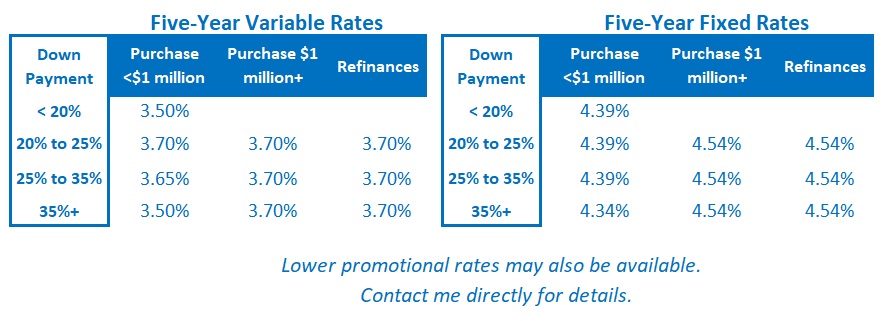
Canadian mortgage lenders continued to raise their fixed rates in response to the recent bond-yield run-up.
Variable-rate mortgage discounts were unchanged last week.
Bond-market investors are pricing in an aggressive series of rate hikes by the BoC. For my part, I think it is unlikely that five 0.25% hikes will materialize by the end of 2027.
My Take on Today’s Mortgage Options
I can well appreciate the appeal of fixed-rate stability in our current volatile environment.
Many of the borrowers I work with today are choosing fixed rates, and I’m not trying to talk anyone out of those options. I see the value of certainty in an increasingly uncertain world even if it comes at higher cost.
When asked for my view on whether a fixed or variable rate is more likely to prove cheaper, I maintain my view that today’s variable rates have the best chance to save borrowers money over their full terms – an admittedly contrarian call right now.
Variable mortgage rates have held steady, but the backdrop that is keeping them in place is anything but stable.
Until recently, two competing risks had been roughly offsetting each other: 1) The upside risk that spiking energy prices will lead to generalized inflation, and 2) the downside risk that the US/Canada trade war will disrupt our economy and cause disinflation.
A resurgence in the energy-price run up has already spooked global bond markets, and GoC bond yields are being taken along for the ride.
For now, higher energy prices are dominating the inflation narrative – and will continue to do so for as long as war rages in the Middle East.
While I recognize the risk that an extended period of elevated energy prices will lead to more generalized inflation pressure, there are reasonable grounds to question whether that outcome is as inevitable as the consensus believes (for the reasons outlined above).
Important note: Anyone choosing a variable rate should do so only if they are comfortable with its inherent potential for volatility. Borrowers must have the financial capacity to withstand higher costs and, in some cases, higher payments.
Fixed rates also come with risk. For example, if bond yields rise sharply in anticipation of higher inflation that doesn’t ultimately materialize, anyone who locked in a fixed rate during the run-up will be paying that associated premium regardless of any subsequent yield/rate reductions.
Insider’s Tip for Borrowers
Your income is the single most important factor on your mortgage application because it confirms your capacity to pay, which is the most reliable indicator of a loan’s overall risk.
This post details the two key income tests that are used by lenders, outlines the basic income documentation that will typically be required, and offers advice on how to put your best foot forward.
Three Posts Every New Visitor to My Blog Should Read
This post provides a detailed comparison of the pros and cons of fixed- and variable-rate mortgages amidst trade-related economic uncertainty.
For myriad reasons, often unanticipated, many Canadians end up having to break their fixed-rate mortgages. This post provides a detailed explanation of the very different ways that lenders calculate their fixed-rate mortgage penalties. The amounts charged can vary significantly from lender to lender.
This post provides a detailed summary of the key terms and conditions to pay attention to in your mortgage contract. (These are not standard and can vary in important ways.)