








Happy Thanksgiving
October 13, 2026
 Last Wednesday we learned US inflation ran hotter than expected last month.
The US Consumer Price Index (CPI) increased from 3.4% in August to 3.7% in September on a year-over-year (y/y) basis and by 0.6% month-over-month (m/m).
US core CPI, which excludes food and energy prices, rose from 2.4% in August to 2.6% in September y/y and by 0.3% m/m.
All those results came in higher than forecast by the consensus.
The bond market’s initial reaction was as expected. US bond yields increased, as did the bets on another 0.25% hike by the US Federal Reserve at its upcoming meeting on October 28.
But then something surprising happened. All the momentum swung the other way.
By Thursday morning the benchmark US ten-year bond yield had dropped by about 0.20% (a big one-day move), and bets on the timing of the Fed’s next rate hike were pushed out to December.
These were the two most immediate causes of the counter-intuitive whipsaw.
First, technology stocks sold off hard, igniting fears of a popping bubble and triggering a surge in demand for safe-haven assets (which drove bond yields lower).
Second, bond-market investors have become more convinced that the Fed will tolerate elevated inflation for a little longer, rather than risk overtightening by raising rates at consecutive meetings.
In an interview last Wednesday, San Francisco Fed President Mary Daly said further tightening would probably be needed, but not urgently. Her comments reinforced earlier signals from New York Fed President John Williams that the Fed could afford to be patient.
Then, on Friday, at an International Monetary Fund event in Bangkok, US Fed Chair Kevin Warsh indicated that the latest economic developments were broadly consistent with the Fed’s outlook when it raised rates in September. Investors interpreted that as a sign the recent inflation surprise hadn’t meaningfully increased the urgency for another hike.
To summarize, US Treasury yields fell sharply last week as a defensive response to concerns about US economic and financial-market vulnerabilities, not because bond-market investors are more confident that US inflation is under control.
Therefore, while last week’s drop in bond yields was welcome news to anyone keeping an eye on the fixed mortgage rates that are priced on them, it is not likely to be a signal that a sustained decline in both is now at hand.
The Latest on Mortgage Rates
Government of Canada (GoC) bond yields finished last week about where they started it, but only after following their US Treasury equivalents on their roller coaster ride up and then back down.
The next catalyst to come will be our September CPI data, which will be released by Statistics Canada today.
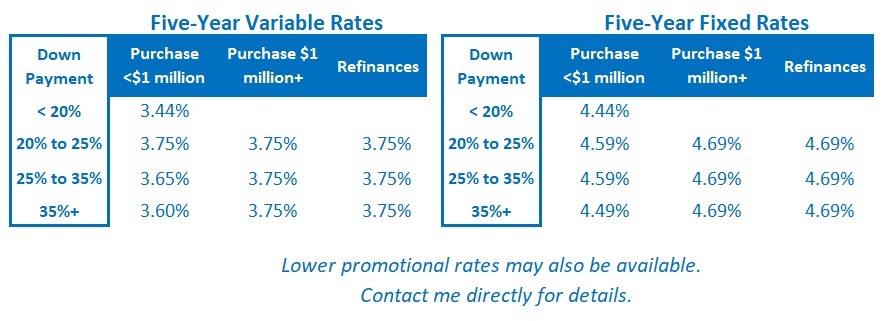
Lenders have raised their fixed mortgage rates multiple times over the past few weeks alongside the steady bond yield run-up. I don’t expect those rates to fall immediately in response to last week’s bond-yield reversal because it was caused by concerns about overall financial stability (which typically pushes risk premiums higher).
Variable-rate mortgage discounts held steady last week.
Bond-market investors continue to price in an aggressive series of rate hikes by the Bank of Canada (BoC) over the next fifteen months. I continue to doubt that the four 0.25% hikes currently priced in will materialize.
My Take on Today’s Mortgage Options
I can well appreciate the appeal of fixed-rate stability in our current volatile environment.
Many of the borrowers I work with today are choosing fixed rates, and I’m not trying to steer anyone away from these options. I see the value of certainty in an increasingly uncertain world, even if it ultimately comes at a higher cost.
That said, when asked for my view on whether a fixed or variable rate is more likely to prove cheaper, I maintain my view that today’s variable rates have the best chance to save borrowers money over their full terms.
Here is a quick overview of the factors underpinning this belief.
Variable mortgage rates have held steady, but the backdrop that is keeping them in place is anything but stable.
Two competing risks had been roughly offsetting each other: 1) The upside risk that higher energy prices will lead to generalized inflation, and 2) the downside risk that the US/Canada trade war will disrupt our economy and cause disinflation.
Then, a resurgence in energy prices (and diesel, in particular) exacerbated upside risks before last week’s sharp tech sell-off re-amplified downside risks.
Upside and downside risks continue as the two forces roughly offset each other, even as both intensify.
While I recognize the risk that an extended period of elevated energy prices will lead to more generalized inflation pressure, I also question whether that outcome is as inevitable as the consensus believes. (For more detail on why I write that, check out this recent post.)
At the same time, the downside risks from an extended US/ Canada trade war are more readily apparent and more likely to accrue (especially if accompanied by a sharp equity market sell-off).
Important note on potential risks when choosing between fixed and variable rates:
- Anyone choosing a variable rate should do so only if they are comfortable with its inherent potential for volatility. Borrowers must have the financial capacity to withstand higher costs and, in some cases, higher payments.
- Fixed rates also come with risk. For example, if bond yields rise sharply in anticipation of higher inflation that doesn’t ultimately materialize, anyone who locked in a fixed rate during the run-up will be paying that associated premium regardless of any subsequent yield/rate reductions.
Insider’s Tip for Borrowers
Does the payment frequency you choose for your mortgage have a material impact on your borrowing cost over time?
The correct answer might surprise you.
Three Posts Every New Visitor to My Blog Should Read
This post provides a detailed comparison of the pros and cons of fixed- and variable-rate mortgages amidst trade-related economic uncertainty.
For myriad reasons, often unanticipated, many Canadians end up having to break their fixed-rate mortgages. This post provides a detailed explanation of the very different ways that lenders calculate their fixed-rate mortgage penalties. The amounts charged can vary significantly from lender to lender.
This post provides a detailed summary of the key terms and conditions to pay attention to in your mortgage contract. (These are not standard and can vary in important ways.)