








Weak Wage Growth Reduces Inflation Risk
November 9, 2026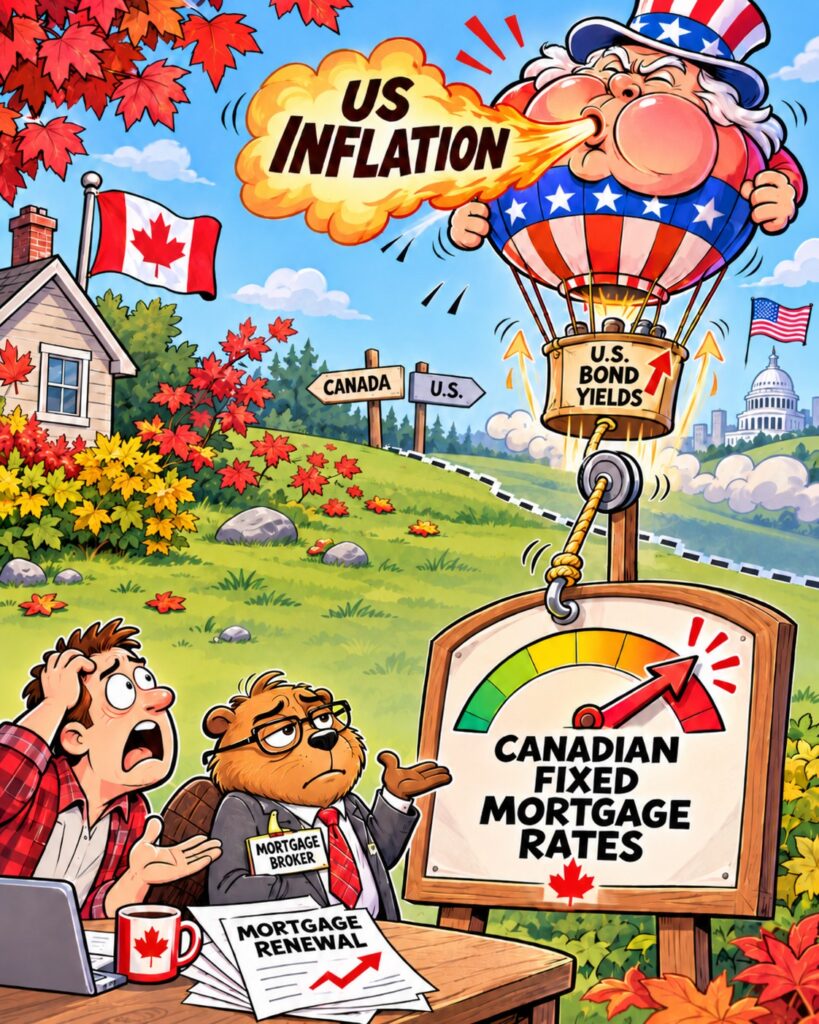
 Last week we learned that the US Consumer Price Index (CPI) increased by 0.4% in October month-over-month (m/m), down from 0.6% m/m in September but higher than the consensus forecast of 0.3%.
The latest year-over-year (y/y) increase could not be calculated because there was no inflation data available last October, due to the US federal government’s shutdown.
Bond market investors are now assigning a 95% probability of another 0.25% hike by the Fed at its next meeting on December 9.
There has even been speculation that the Fed might hike by 0.50%. Fed Governor Christopher Waller warned that might be necessary if US core CPI (which strips out food and energy prices) increased by 0.3% m/m or more. It was subsequently confirmed at 0.3% for the third consecutive month.
Bond market investors aren’t pricing in a 0.50% hike in December at this point, but they are currently assigning 71% odds that the Fed will hike by another 0.25% at its meeting on January 27.
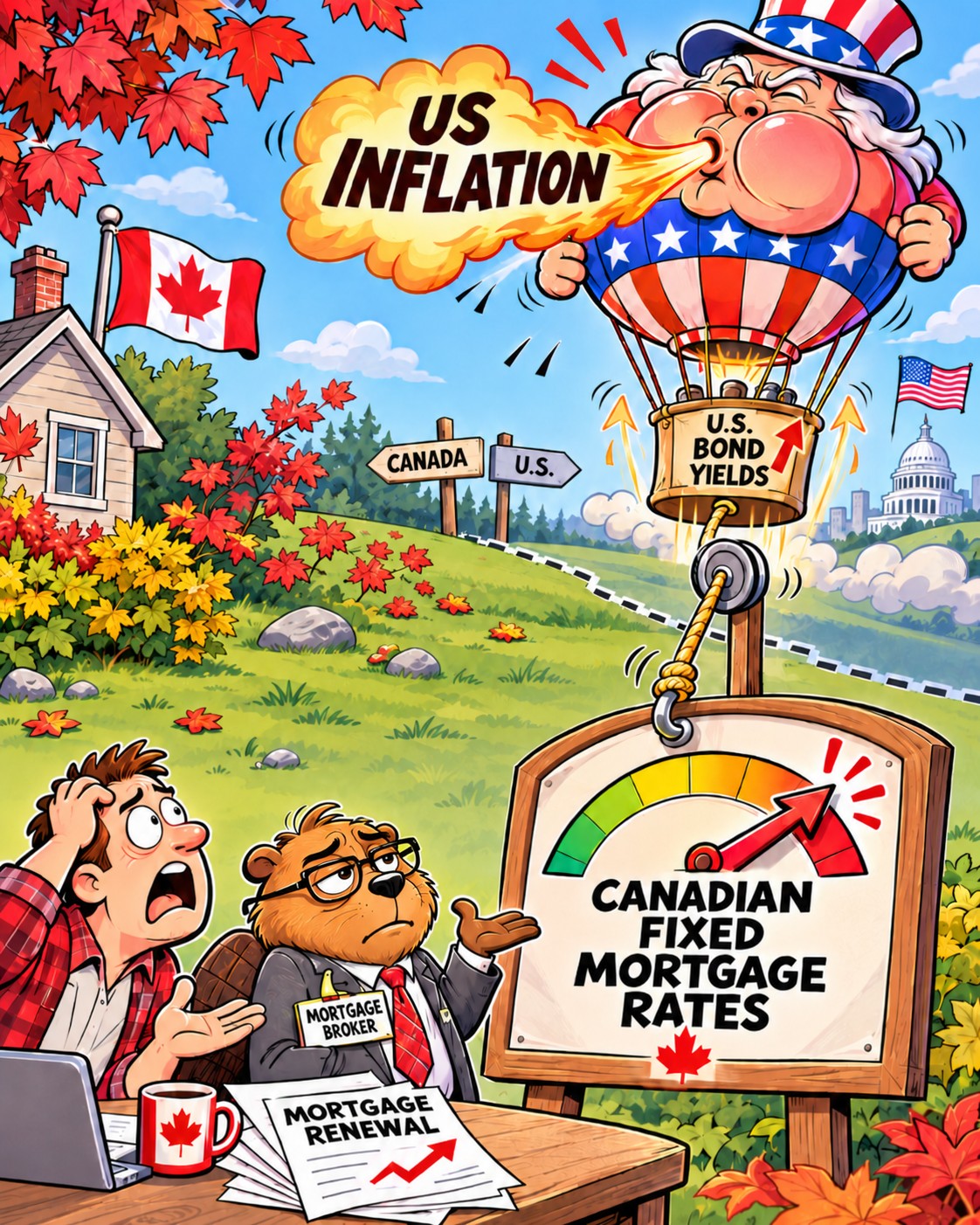
This latest data has exacerbated concerns that US inflation is both sticky and spreading. Bond-market investors have responded by pushing up US Treasury yields, and their gravitational pull has meant that Government of Canada (GoC) bond yields and therefore Canadian fixed-mortgage rates are being taken along for the ride.
Canadian variable mortgage rates, on the other hand, have not been directly impacted. They follow the Bank of Canada’s (BoC) policy-rate path, and the Bank’s attention is focused on inflation conditions here at home.
That is an important point because Canadian inflation looks very different from US inflation right now.
Our headline inflation rate is lower: 3.1% CDN vs 3.7% US (annualized). So are our key measures of core inflation: 1.8% trim/1.9% median vs 2.6% US-core (annualized).
The composition of our inflation pressure is also different. In Canada, inflation is mostly being driven by energy and import costs, whereas in the US, inflation pressure is coming from a mix of energy and service costs, with US producer and goods costs also recently accelerating.
To be clear, that doesn’t mean we’re out of the sugar maples yet.
The BoC is concerned that our inflation may start to spread in ways that are like what we are seeing south of the border. But there is much less evidence of that occurring at this point, and that gives us a wider buffer for withstanding the ongoing energy shock and a longer runway for non-inflationary growth (ex-energy).
We’ll be receiving our latest inflation data from Statistics Canada right about the time that I launch this post tomorrow (I am writing this on Sunday evening).
If our key measures of core inflation (CPI-trim and CPI-median) remain near 2%, and if there continues to be limited evidence of more generalized inflation, that will bolster my view that the Canadian and US economies call for divergent monetary-policy responses (even as our bond markets remain closely correlated).
The Latest on Mortgage Rates
GoC bond yields rose sharply last week.
The two main factors were hotter-than-expected US inflation data and hawkish Federal Reserve commentary, which caused investors to price in more near-term Fed rate hikes.
The next catalyst for GoC bond yields will be Stats Can’s release of our latest inflation data (for October) to start this week. A softer report will help to underline the differences between current US and Canadian inflation pressures, but an upside inflation surprise might add another leg to last week’s bond-yield surge.
Fixed mortgage rates and variable-rate discounts both held steady last week.
Bond-market investors went from assigning roughly a one-in-three chance of a 0.25% rate hike by the BoC on December 9 to nearly a two-in-three chance (with three more 0.25% hikes priced in for next year).
That swing can be largely attributed to the release of the minutes from the BoC’s latest policy-rate meeting on October 28. Bond-market investors keyed in on the Bank’s emphasis on the risk that elevated energy costs may fuel broader inflation.
My Take on Today’s Mortgage Options
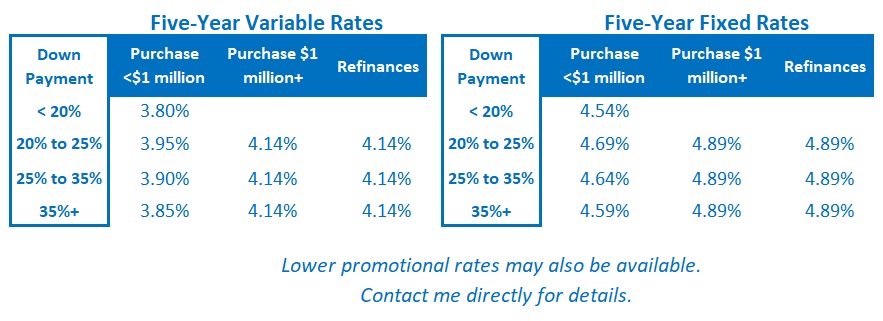
Many of the borrowers I am currently working with are choosing fixed rates, and I can well appreciate the appeal of fixed-rate stability in our current volatile environment. I see the value of certainty in an increasingly uncertain world, even if it ultimately comes at higher cost.
When asked for my take on whether a fixed or variable rate is more likely to prove cheaper, I maintain my view that today’s variable rates have the best chance to save borrowers money over their full terms.
Variable mortgage rates may well increase further in the months ahead. But they will have to increase by a full 1.00% to reach levels equivalent to most of today’s available fixed rates. I think that is unlikely.
While there is risk that higher energy prices may lead to more generalized inflation, there is little evidence of that thus far (unlike in the US), and that difference will allow the BoC to keep its policy rate in its neutral-rate range between (2.25% to 3.25%) for longer.
GoC bond yields and the Canadian fixed rates that are priced on them are being pulled higher by more widespread and stickier US inflation, due to the gravitational pull of US Treasuries. But our variable rates will continue to follow the BoC’s policy-rate path, which is tied to more benign Canadian inflation.
Important notes on potential risks when choosing between fixed and variable rates:
- Anyone choosing a variable rate should do so only if they are comfortable with its inherent potential for volatility. Borrowers must have the financial capacity to withstand higher costs and, in some cases, higher payments.
- As outlined above, fixed rates also come with risk. For example, if bond yields rise sharply in anticipation of higher inflation that doesn’t ultimately materialize, anyone who locked in a fixed rate during the run-up will be paying that associated premium for the balance of their mortgage term regardless of any subsequent rate reductions.
Insider’s Tip for Borrowers
This post offers mortgage advice to homeowners who are trying to work through a divorce.
It outlines some key steps that must be taken prior to removing a spouse from title and/or completing a refinancing to buy them out. It also includes several other useful tips that I have accumulated over many years of helping borrowers navigate a marital split.
Three Posts Every New Visitor to My Blog Should Read
This post provides a detailed comparison of the pros and cons of fixed- and variable-rate mortgages amidst trade-related economic uncertainty.
For myriad reasons, often unanticipated, many Canadians end up having to break their fixed-rate mortgages. This post provides a detailed explanation of the very different ways that lenders calculate their fixed-rate mortgage penalties. The amounts charged can vary significantly from lender to lender.
This post provides a detailed summary of the key terms and conditions to pay attention to in your mortgage contract. (These are not standard and can vary in important ways.)