








Canadian Employment Data Much Stronger than Expected (Again)
August 10, 2026
Canada Hits Back
August 24, 2026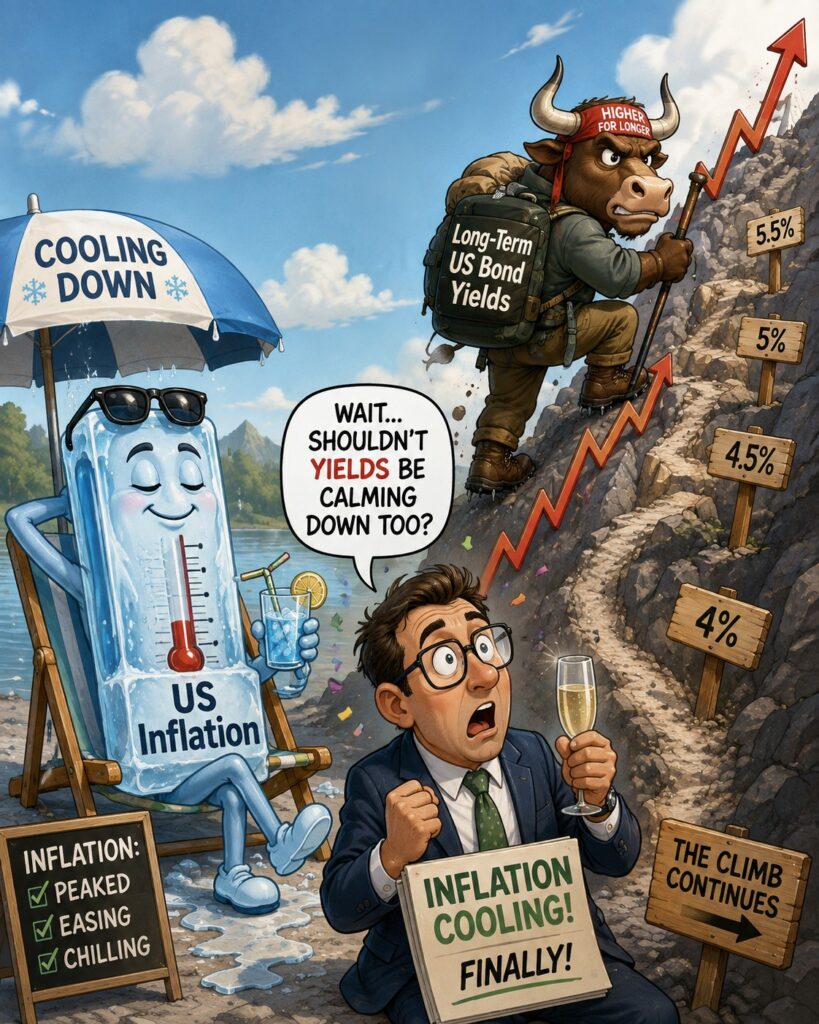
 Last week was relatively quiet for mortgage-related news.
The most noteworthy update was the release of the latest US Consumer Price Index (CPI). It decreased from 3.5% in June to 3.4% in July on an annualized basis and rose by 0.1% on a month-over-month basis. Both results were in line with consensus expectations.
US core inflation, which strips out food and energy costs, decreased from 2.6% in June to 2.5% in July (annualized), returning it to its pre-Iran war level. This latest result will help ease concerns that spiking energy prices are causing more generalized inflation pressure.
US bond-market investors slightly decreased their bets on a hike by the US Federal Reserve at its next meeting on September 15 from 50% to 40%. Realistically, the Fed is unlikely to move its policy rate so close to the mid-term elections on Nov 3 (to avoid the appearance of trying to influence those results). With that in mind, US bond-market investors are betting that the Fed’s long-expected hike will occur at its first post-election meeting on December 9.
The latest US CPI data provided reassurance that near-term tariff and war-related pressures are easing, and the weaker-than-expected US employment report for July was a warning that the US economy may be weakening. But that didn’t stop bond-market investors from continuing to push long-term US bond yields higher.
The US 30-yr Treasury yield recently hit its highest level (5.216%) in 25 years. A combination of factors has caused investors to price in more long-term risk to US Treasury yields:
- Persistent above-target inflation
- The US federal government’s record budget deficit
- A sharp increase in the issuance of new US Treasuries.
This trend is important to note for two main reasons:
- Roughly 85% to 90% of US residential mortgage borrowers opt for 30-yr fixed-rate terms (according to the US Federal Housing Finance Agency). As such, the path of the 30-yr treasury yield, on which those rates are priced, matters more than the Fed policy rate to US home buyers, and arguably, to the overall US economy.
- The Fed can’t ignore the slow grind higher of long-term US Treasury yields. Their continued rise may compel the Fed to hike its policy rate regardless of what the next employment and inflation reports say.
The Latest on Mortgage Rates
Government of Canada (GoC) bond yields continued their recent pattern. They bounced both higher and lower before finishing the week about where they started.
Statistics Canada will release our latest inflation data this morning, which may cause some movement in GoC bond yields. But the bigger story will be whether the US imposes new 50% tariffs on another swath of Canadian exports on August 19 (many of which are supposed to be captured under the existing CUSMA agreement).
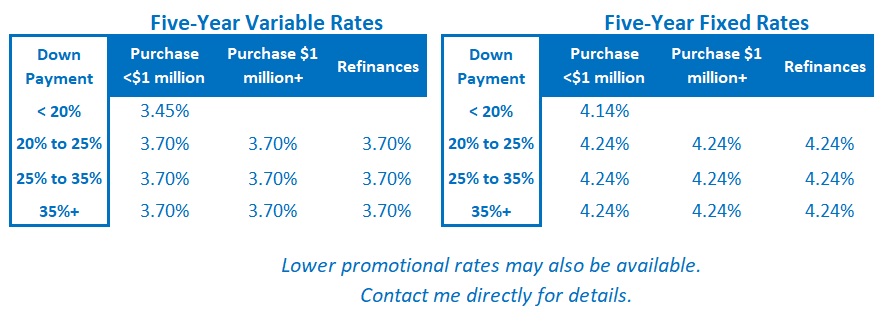
Fixed mortgage rates held steady last week, as did the discounts offered on today’s variable-rate mortgages.
Our recent run of stronger-than-expected domestic economic data has helped to assuage ongoing concerns about the negative economic impacts stemming from trade uncertainty and geopolitical instability.
Those roughly offsetting factors have helped keep our mortgage rates range bound and the Bank of Canada (BoC) on hold. There is enough on the table this week to break this uneasy balance (but I’ll believe it when I see it).
My Take on Today’s Mortgage Options
My take is the same as last week.
Fixed rates remain range bound, despite continued volatility in GoC bond yields.
Three- and five-year terms remain the most popular choices. If the spread between those two options is minimal, I think five-year terms offer better value.
While I appreciate the appeal of fixed-rate stability in our current volatile environment, I continue to believe that variable rates will likely prove cheaper over their full terms.
(Important note: Anyone choosing a variable rate should do so only if they are comfortable with its inherent potential for volatility. Borrowers must also have the financial capacity to withstand higher costs and, in some cases, higher payments.)
The BoC continues to look through our recent inflation spike because it has thus far been limited to surging energy prices. If the US/Iran war drags on and its associated inflationary impacts become broader and more entrenched, there may come a time when the Bank will be compelled to tighten.
I don’t think we will get to that point soon.
Meanwhile, trade uncertainty remains the greater long-term threat to our economy. US President Trump’s latest tariff threats are a reminder of that.
Insider’s Tip for Borrowers
If you’re in the market for a mortgage, instead of focusing on how much you can borrow, you will be far better off in the long run by focusing on how much you can (conservatively) afford to pay.
A lender doesn’t care if you ever save for retirement, take a vacation, or go out for a nice dinner. With that in mind, when you decide how much you will borrow, focus on what works for your budget, not on the maximum amount you can borrow.
This post offers advice on how to work out a reasonable mortgage budget using two different approaches: the easy way and the hard way.
Three Posts Every New Visitor to My Blog Should Read
This post provides a detailed comparison of the pros and cons of fixed- and variable-rate mortgages amidst trade-related economic uncertainty.
For myriad reasons, some of them unanticipated, many Canadians end up having to break their fixed-rate mortgages. This post provides a detailed breakdown of the very different ways that lenders calculate their fixed-rate mortgage penalties. The amounts charged can vary significantly from lender to lender.
This post provides a detailed summary of the key terms and conditions to pay attention to in your mortgage contract. (They are not standard and can vary in important ways.)