








Canadian Inflation Was Cooler Than Expected in June
July 27, 2026
US Inflation Cools, But Long-Term US Bond Yields Grind Higher Anyway
August 17, 2026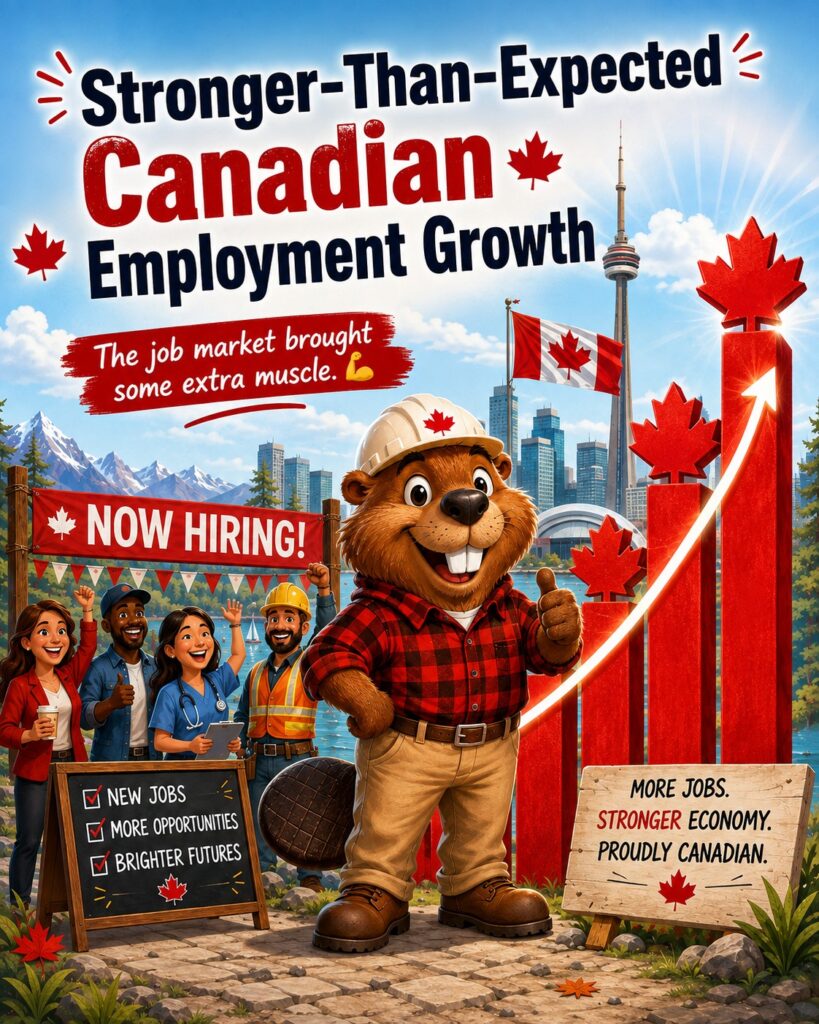
 Last week Statistics Canada confirmed that our economy added a whopping 75,000 new jobs last month, well above the consensus forecast of 20,000.
The gains were broad-based across several key sectors, mostly in Ontario, and they were split almost evenly between full-time and part-time positions. All the gains were either in the private sector (+58,000) or in self-employment (+44,000). The public sector shed 27,000 jobs.
Our unemployment rate also declined from 6.5% in June to 6.4% in July, marking a two-year low. That drop occurred despite 60,500 more Canadians joining the labour force last month.
Our labour market has been on an impressive run of late. We have added a total of 181,000 new jobs over the past three months, handily beating the consensus estimates (which totaled 36,500 during that period).
Average wage growth slowed a little last month, from 3.3% in June to 2.8% in July. Slowing wage growth alongside increasing demand for labour serves as confirmation that our economy still has ample room for non-inflationary growth.
The latest employment data line up nicely with Stats Can’s recent GDP estimates showing that our economy has rebounded strongly from its slow start to the year. That resilience in the face of heightened geopolitical and trade uncertainty is encouraging, but the risks associated with those powerful headwinds remain.
The Latest on Mortgage Rates
Government of Canada (GoC) bond yields barely moved in response to our strong jobs report because the corresponding US employment data, also released last Friday, were about as weak as ours were strong.
The US economy shed 23,000 jobs in July, well below the 80,000 gain expected by the consensus. The previous estimates for May and June were also reduced by 103,000. Average hourly earnings growth hit a five-year low of 3.2% (annualized).
In the face of these contrasting influences, mortgage rates held mostly steady last week, as did the discounts offered on today’s variable-rate mortgages.
Our recent string of stronger-than-expected domestic economic data reduces the odds that we will see a BoC rate cut soon. But a BoC rate hike seems at least as unlikely to me. Our economy has plenty of unused capacity, today’s inflation pressure is both contained and cooling, and new US tariffs are set to kick in on August 19.
For now, the forces that are pulling inflation in either direction continue to roughly offset each other.
My Take on Today’s Mortgage Options
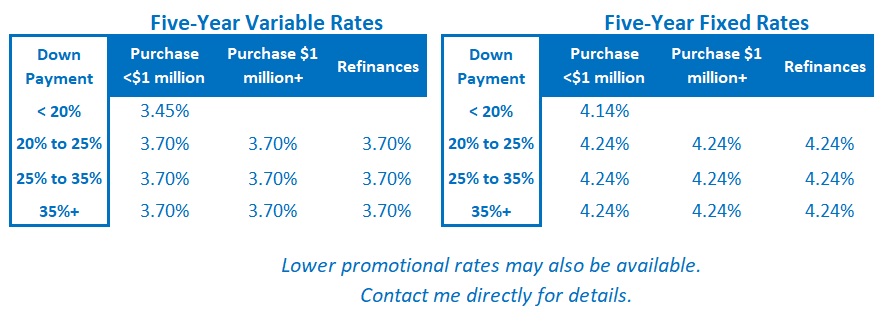
Fixed rates remain range bound, despite continued volatility in GoC bond yields.
Three- and five-year terms remain the most popular choices. If the spread between those two options is minimal, I think five-year terms offer better value.
While I appreciate the appeal of fixed-rate stability in our current volatile environment, I continue to believe that variable rates will likely prove cheaper over their full terms.
(Important note: Anyone choosing a variable rate should do so only if they are comfortable with its inherent potential for volatility. Borrowers must also have the financial capacity to withstand higher costs and, in some cases, higher payments.)
The BoC continues to look through our recent inflation spike because it has thus far been limited to surging energy prices. If the US/Iran war drags on and its associated inflationary impacts become broader and more entrenched, there may come a time when the Bank will be compelled to tighten.
I don’t think we will get to that point soon.
Meanwhile, trade uncertainty remains the greater long-term threat to our economy. US President Trump’s latest tariff threats are a reminder of that.
Insider’s Tip for Borrowers
Borrowers often ask me about the impact that a credit check will have on their scores. This post demystifies how credit scores are calculated and highlights the factors that matter most.
(Spoiler alert: while a periodic credit check does technically drop your score, the impact is both minor and temporary.)
Three Posts Every New Visitor to My Blog Should Read
This post provides a detailed comparison of the pros and cons of fixed- and variable-rate mortgages amidst trade-related economic uncertainty.
For myriad reasons, some of them unanticipated, many Canadians end up having to break their fixed-rate mortgages. This post provides a detailed breakdown of the very different ways that lenders calculate their fixed-rate mortgage penalties. The amounts charged can vary significantly from lender to lender.
This post provides a detailed summary of the key terms and conditions to pay attention to in your mortgage contract. (They are not standard and can vary in important ways.)