







How Stickier US Inflation Will (and Won’t) Impact Canadian Mortgage Rates
November 16, 2026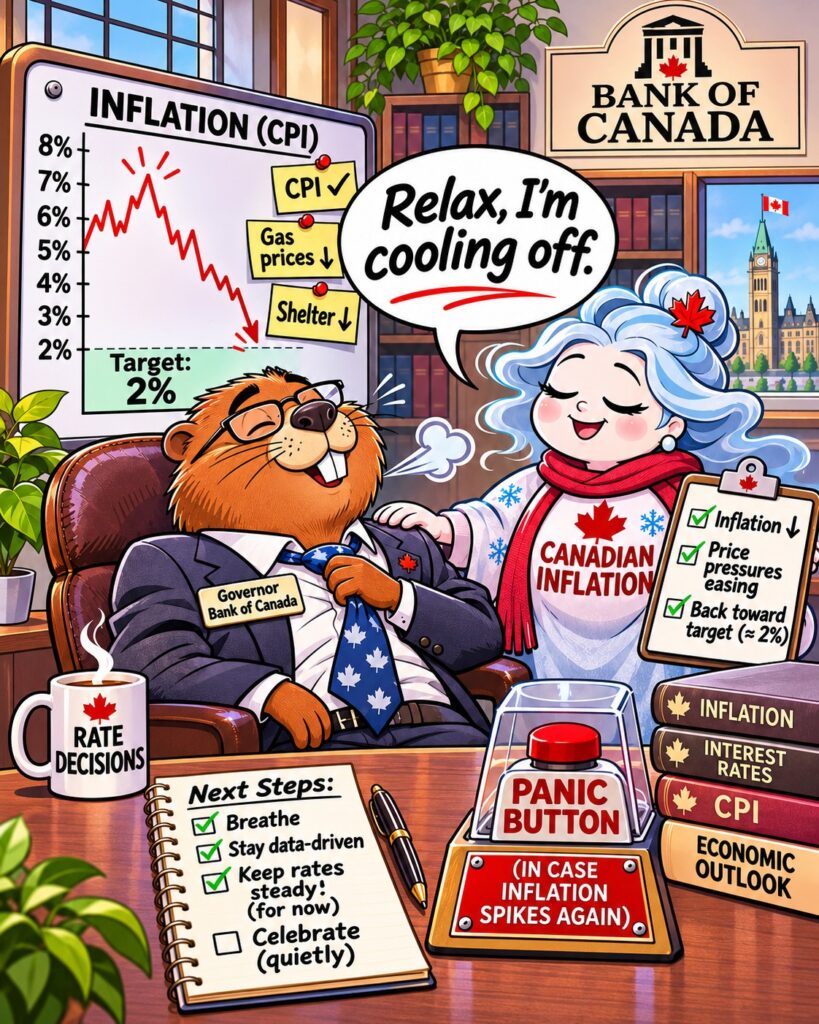
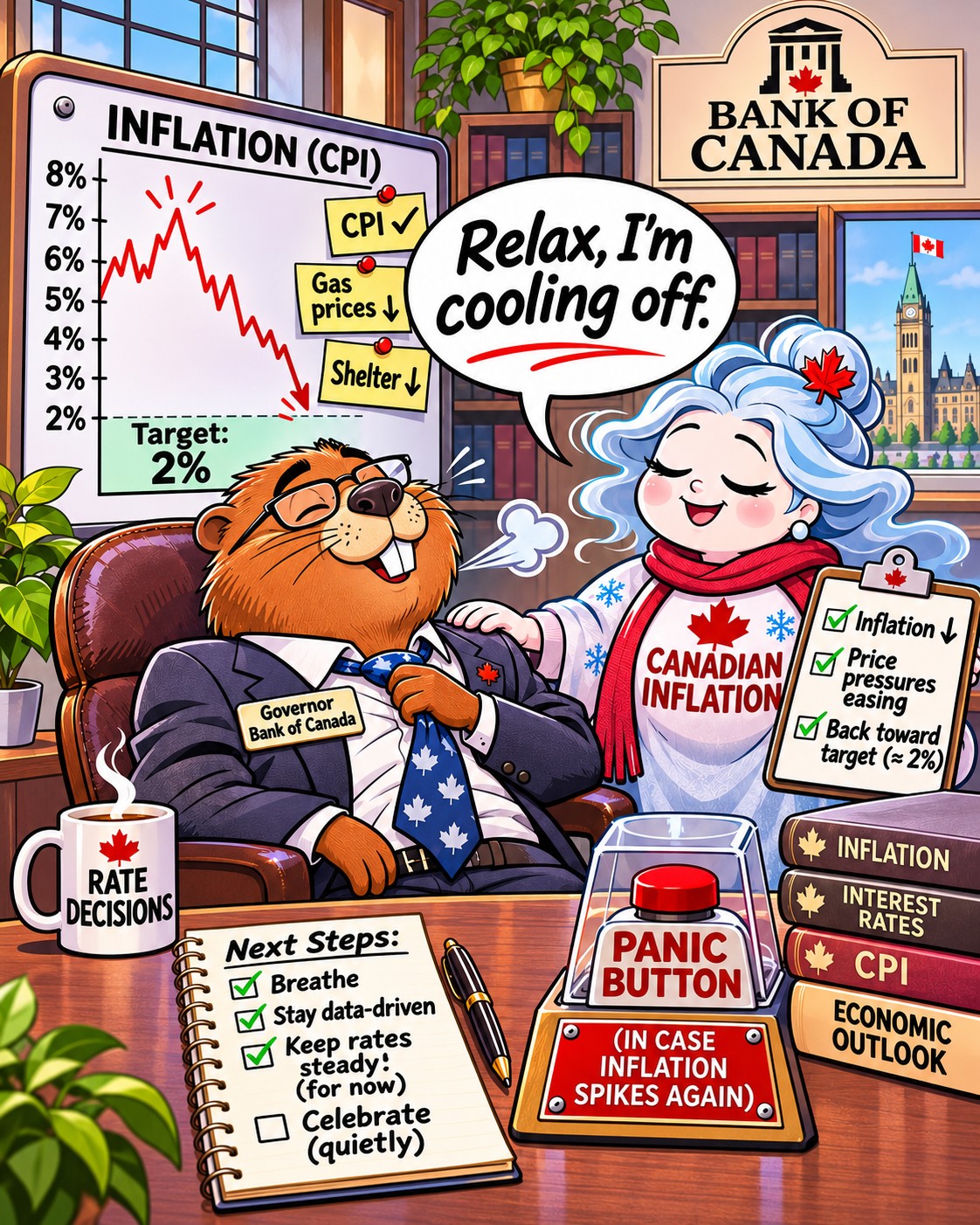 Last week Statistics Canada confirmed that our headline Consumer Price Index (CPI) increased by 3.1% in October on a year-over-year (y/y) basis, slightly below the consensus forecast of 3.2%.
Gasoline prices remained the key source of inflation pressure, increasing last month by 31% y/y. That said, they have fallen sharply in November and that drop will exert substantial downward pressure on our next headline CPI print.
The average of the Bank of Canada’s (BoC) two key gauges of core inflation (CPI-median and CPI-trim) cooled slightly last month to 1.9% y/y.
Those same gauges have averaged 2.4% (annualized) over the past six months, which helps to explain the Bank’s concern that underlying cost pressures are building. Both CPI-trim and CPI-median increased by 0.2% month-over-month (m/m) in October, confirming that they stabilized over that period.
If the BoC continues to “proceed carefully” and remains committed to taking “future decisions one meeting at a time” it seems increasingly unlikely that it will hike its policy rate by another 0.25% at its next meeting on December 9.
Let’s take a quick look at how the BoC’s most recent forecasts compared to the key economic data that have been released since its last policy-rate meeting on October 28:
- The Bank forecasted our overall CPI at 3.4% (annualized) in Q4. It just came in at 3.1% in October, and this month’s sharp drop in gasoline prices make it highly likely that it will drop lower still next month.
- The Bank projected our GDP growth at 2.0% in Q4. Stats Can’s latest data have it tracking at closer to 1.3%.
- The Bank forecasted that our economy would absorb its available labour-market slack over its three-year forecast horizon. Stats Can confirmed that our economy shed another 4,700 jobs in October and our unemployment rate increased from 6.5% in September to 6.7% last month. Labour-market slack is increasing, and we have now lost 115,000 jobs over the past three months, our worst run in more than five years.
- The Bank forecasted steadily increasing consumption would contribute to price pressure. But Stats Can’s initial estimate for retail spending in October (released last week) was -1.5%. Weakening consumption will help to reduce demand-driven inflation.
To summarize, the BoC positioned its October hike as a form of insurance against the build up of energy-related cost pressures. While those are evident, they are still largely contained and are therefore still not overly concerning.
The Bank also assessed that our “resilient” economy was absorbing its available slack and thereby reducing its runway for non-inflationary growth. The data released since then paint the opposite picture.
The Latest on Mortgage Rates
Government of Canada (GoC) bond yields fell sharply last week.
While cooler-than-expected inflation, weaker signals of economic growth, and falling oil prices all contributed to that drop, the primary driver was the flight to safety caused by global stock-market turmoil.
Simply put, it’s always a good week for bonds when investors are more worried about the return of their capital than the return on their capital.
Fixed mortgage rates held steady last week but there is room for lenders to start reducing those rates if GoC bond yields stabilize near their current levels.
Variable rate discounts off prime were unchanged.
Bond-market investors reduced their bets on a 0.25% rate hike by the BoC at its next meeting on December 9 from a two-in-three chance to basically a coin toss last week. For the reasons outlined above, I think our recent string of softer-than-expected economic data will make it hard for the Bank to justify another move.
My Take on Today’s Mortgage Options
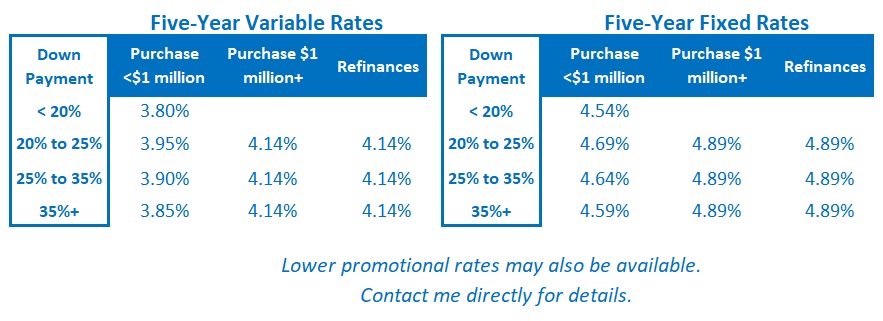
Many of the borrowers I am currently working with are choosing fixed rates, and I can well appreciate the appeal of fixed-rate stability in our current volatile environment. I see the value of certainty in an increasingly uncertain world, even if it ultimately comes at higher cost (as most forms of insurance usually do).
When asked for my take on whether a fixed or variable rate is more likely to prove cheaper, I maintain my view that today’s variable rates have the best chance to save borrowers money over their full terms.
Variable mortgage rates may well increase further in the months ahead. But I doubt they will rise to levels that are equivalent to most of today’s available fixed rates.
GoC bond yields and the Canadian fixed rates that are priced on them have been pulled higher by the gravitational pull of US Treasuries, which have risen in response to stickier and more widespread US inflation. But our variable rates will continue to follow the BoC’s policy-rate path, which is tied to more benign Canadian inflation.
While the risk that higher energy prices may lead to more generalized inflation remains, there is little evidence of that thus far (unlike in the US). Our current backdrop should help to keep the BoC’s policy rate in its neutral-rate range (between 2.25% to 3.25%) for longer.
Important notes on potential risks when choosing between fixed and variable rates:
- Anyone choosing a variable rate should do so only if they are comfortable with its inherent potential for volatility. Borrowers must have the financial capacity to withstand higher costs and, in some cases, higher payments.
- As outlined above, fixed rates also come with risk. For example, if bond yields rise sharply in anticipation of higher inflation that doesn’t ultimately materialize, anyone who locked in a fixed rate during the run-up will be paying that associated premium for the balance of their mortgage term regardless of any subsequent rate reductions.
Insider’s Tip for Borrowers
Does the payment frequency you choose for your mortgage have a material impact on your borrowing cost over time?
The correct answer might surprise you.
Three Posts Every New Visitor to My Blog Should Read
This post provides a detailed comparison of the pros and cons of fixed- and variable-rate mortgages amidst trade-related economic uncertainty.
For myriad reasons, often unanticipated, many Canadians end up having to break their fixed-rate mortgages. This post provides a detailed explanation of the very different ways that lenders calculate their fixed-rate mortgage penalties. The amounts charged can vary significantly from lender to lender.
This post provides a detailed summary of the key terms and conditions to pay attention to in your mortgage contract. (These are not standard and can vary in important ways.)